The best way to climb Adam's Peak (Sri Pada) is during the pilgrim season, from the Hatton side, starting between about 1:30 and 2:30 am so you reach the summit before sunrise. The 2026/27 season opens on 23 December 2026 (Unduvap Poya) and runs until Vesak Poya in May 2027. Expect roughly 5,500 steps and 3 to 5 hours up on a normal night, and much longer on weekends and full moon days.
This guide covers when to go, which trail to take, how to get to the start while the hill country railway is partly closed, what the climb is actually like, and what to bring.
Updated November 2026.
Adam's Peak at a glance
| Question | Short answer |
|---|---|
| Season 2026/27 | 23 December 2026 (Unduvap Poya) to Vesak Poya in May 2027 |
| Height | About 2,243 m |
| Steps | Around 5,500 on the Hatton (Nallathanni) trail; counts vary |
| Trail length | About 5 km one way from Nallathanni |
| Time up | 3 to 5 hours on a quiet night; 6 hours or more on busy weekends |
| Usual start time | 1:30 to 2:30 am; earlier on weekends and Poya days |
| Sunrise | Around 6 am |
| Entry fee | No ticket to climb in season; donations at the temples are customary |
| Best months | January to March |
| Trains to Hatton | Not running from Colombo or Kandy as of November 2026; go by road |
What is Adam's Peak?
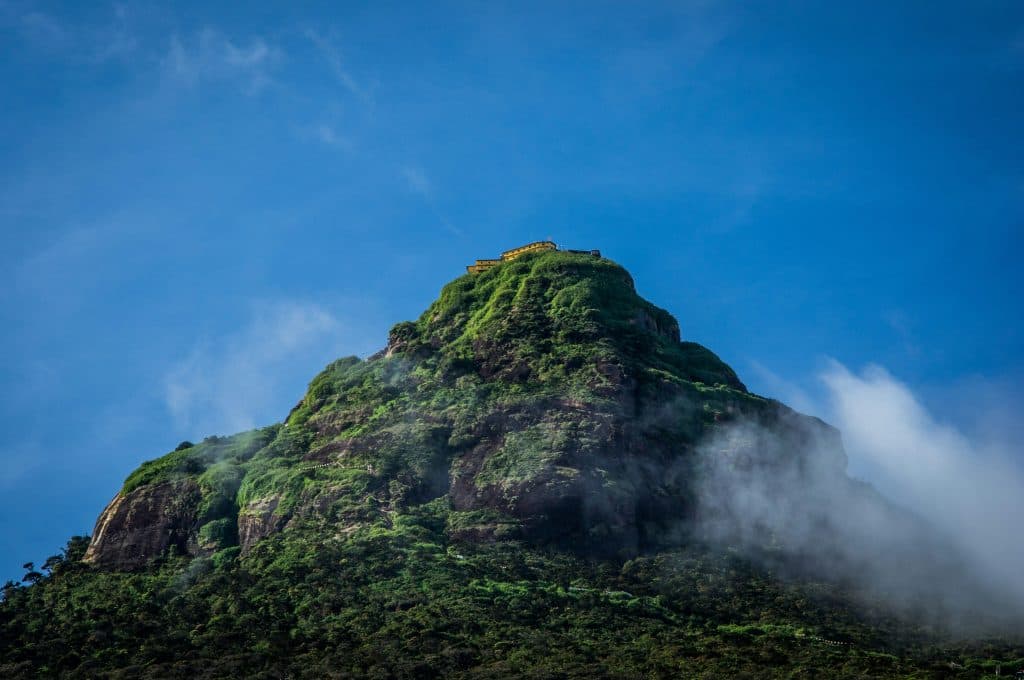
Adam's Peak, called Sri Pada in Sinhala, is a steep, cone-shaped mountain at the edge of the central highlands. On the summit is a small shrine built over a rock formation shaped like a large footprint. Buddhists believe it is the footprint of the Buddha, Hindus associate it with Shiva, and some Muslims and Christians link it to Adam. That shared meaning is why you will climb alongside families, elderly pilgrims and monks, not just hikers.
Keep that in mind on the way up. For many people on the steps this is a once-in-a-lifetime pilgrimage, not a sunrise photo trip. Walk quietly near the shrines, give way to older pilgrims, and follow what the temple staff ask.
When to climb: the pilgrim season
The official season runs from the Unduvap full moon in December to the Vesak full moon in May. During these months the path is lit all night, tea shops are open along the way, and there are first-aid posts. For 2026/27, the season begins on 23 December 2026, according to the Sunday Times and Ada Derana. The sacred relic casket and the statue of the deity Saman are carried up in processions on 22 December, and the season opens in the early hours of the 23rd.
Within the season, the timing matters a lot:
- January to March is the sweet spot. Skies are clearest and it's busy but manageable on weeknights.
- Weekends, Poya (full moon) days and public holidays bring huge crowds. Queues near the top can stop you completely for long stretches, and you may need to start before midnight to see sunrise.
- Opening night in December and Vesak in May are the busiest nights of the year. Go for the atmosphere, not for an easy climb.
- April is still in season but busier and hazier, and the afternoon rains start to build.
If you are in Sri Lanka in late November or early December, note that the season has not started yet. The December guide covers what else is good at that time of year.
Can you climb outside the season?
Yes, but it is a different experience and not one we'd recommend for first-timers. From late May to December the steps are unlit, the tea shops are closed and there is no first aid on the mountain. The south-west monsoon brings heavy rain, strong wind, mist and leeches, and the steps get slippery. Visit Ceylon's Hatton route guide also notes rockfall risk on the steep Mahagiri Damba section and says off-season climbers may need permission from the Nallathanniya police station.
If you do go off-season, climb in daylight with a local guide, check the weather the night before, and turn back if it is raining hard. The temple's chief monk has also raised concern about environmental damage from off-season visitors, so carry all your rubbish down.
Which trail to take
Several old pilgrim routes lead to the summit. Almost all foreign visitors use the first one.
Hatton (Nallathanni / Dalhousie) trail
The shortest and most popular route starts in the village of Nallathanni, also called Dalhousie, about an hour or so by road from Hatton. It is roughly 5 km one way, almost all on concrete and stone steps, and gets steeper towards the top. This is the route with the most tea shops, rest stops and guesthouses at the start.
Ratnapura (Palabaddala) trail
The old route from the Ratnapura side starts near Palabaddala. It is much longer and harder, typically seven hours or more up, and passes through forest. It is quieter, but you'll want a guide and a good level of fitness.
Other routes
There are also routes from the Kuruwita/Erathna side. They are quiet and forested, with fewer facilities. Go with a local guide who knows the current state of the path.
Trail condition after Cyclone Ditwah
Cyclone Ditwah in late November 2025 caused a major landslide at Mahagiri Damba on the Hatton route, and a later slip at Indikatu Paana. At the planning meeting for the new season on 18 November 2026, the temple's chief monk thanked the government for the restoration work, and officials said they were clearing landslide debris and removing beehives along the Nallathanni route before the season opens (Ada Derana). Separately, a landslide in August 2026 blocked the Nallathanniya–Sri Pada road near Ehela Kanuwa.
The trail is expected to be ready for the season, but conditions on a mountain like this can change after heavy rain. Ask at your guesthouse in Nallathanni the day you arrive.
Getting to Nallathanni
Before the cyclone, most people took the train to Hatton. As of November 2026, that isn't possible: the hill country railway is running only between Nanu Oya, Ella and Badulla, and trains from Colombo and Kandy are suspended. Railway officials have talked about reopening dates from late 2026 into 2027, so check the latest before you travel. Our Kandy to Ella train guide has the current status of the line.
For now, plan to go by road:
- By car with a driver: Colombo to Nallathanni is roughly 135 to 150 km and takes about 4 to 4.5 hours. This is the easiest option, especially if you combine it with Kandy, Nuwara Eliya or Ella. See hiring a driver in Sri Lanka for daily rates.
- By bus: take a bus to Hatton, then a local bus or tuk-tuk to Nallathanni, which takes about 1 to 1.5 hours. Off-season the direct Hatton bus may not run, and you may need to go via Maskeliya.
- From Ella or Nuwara Eliya: you can take the train as far as Nanu Oya from Ella, then continue by road to Hatton and Nallathanni.
Most people sleep in Nallathanni the night before, go to bed early, and set an alarm for around 1 am.
What the climb is like
The first part from Nallathanni is gentle. You pass the entrance arch (Makara Thorana) and the first of many tea shops. The steps get steeper and narrower as you go, and the last stretch is the hardest: steep, crowded and often windy, with handrails to hold.
A few things to expect:
- Pace yourself. Short stops at the tea shops help more than one long break. Pilgrims of all ages make it up, so going slowly is completely normal.
- It gets cold. The summit is exposed and can be very cold before dawn, especially once you stop moving and wait for sunrise. A warm layer and a windproof jacket make a big difference.
- Arrive by about 5 am. Sunrise is around 6 am, and you'll want to be in place on the summit terraces before the crowd fills them. Start heading down from about 7 am.
- The descent is hard on the knees. Allow 2 to 3 hours to come down, sometimes more. Many people find it harder than the climb.
Summit etiquette and rules
- Dress modestly: cover your shoulders and knees. Many Sri Lankan pilgrims wear white.
- Take off your shoes at the summit temple.
- Photography is not allowed in the inner shrine area around the footprint. Follow the signs and the temple staff. Views from the outer terraces are fine.
- Drones are generally restricted around the summit.
- Keep your voice down, and ask before photographing pilgrims.
- Carry all plastic back down. Litter on the trail is a real problem and adds to slope damage.
How much does it cost?
There is no ticket to climb Adam's Peak during the pilgrim season. A small donation at the temples is customary. A wildlife department counter at Makara Thorana may charge an entry fee outside the season, but this varies, so check locally. Your real costs are transport to Nallathanni, a night's accommodation there, and food and drinks on the way up.
What to bring
- A warm fleece or jumper, and a light windproof or rain jacket
- Comfortable shoes with good grip; trainers are fine in season
- A head torch, useful even in season if the lights fail or you climb off-season
- Water and a few snacks (water is available on the way, but having your own helps on the steep section)
- Cash in small notes for tea, snacks and donations
- Something to sit on at the summit while you wait, and a dry layer to change into
- A cover-up for shoulders and knees if you're wearing hiking clothes
Our Sri Lanka packing list covers the hill country in more detail.
Frequently asked questions
How long does it take to climb Adam's Peak?
From Nallathanni, about 3 to 5 hours up and 2 to 3 hours down on a quiet night. On weekends and Poya days, queues can push the climb to 6 hours or more.
Is Adam's Peak hard to climb?
It is tiring rather than technical. The path is steps all the way, so anyone in reasonable health can do it at a slow pace. The top section is steep, and the descent is tough on the knees.
When does the Adam's Peak season start in 2026?
The 2026/27 pilgrim season starts on 23 December 2026, the Unduvap Poya day, and ends on Vesak Poya in May 2027.
Can you take the train to Adam's Peak?
Not at the moment. Trains from Colombo and Kandy to Hatton have been suspended since Cyclone Ditwah, so you need to go by road. Check the current status of the line before you travel, as reopening is planned.
Do you need a guide for Adam's Peak?
Not in season on the Hatton trail: the path is lit and busy all night. A local guide is a good idea off-season, and on the longer Ratnapura and Kuruwita routes.