Sri Lanka's Cultural Triangle is the dry-zone heartland between Anuradhapura, Polonnaruwa and Kandy, with Sigiriya and Dambulla in the middle. If you have limited time, base yourself near Sigiriya or Dambulla for three nights and visit Polonnaruwa as a day trip, then add Anuradhapura if you have a fourth day. Expect to pay US$30 each for Anuradhapura and Polonnaruwa, US$35 for Sigiriya and Rs. 3,000 for the Dambulla cave temple in 2026.
This guide covers what each site is like, what it costs, how many days to give it, the best order to see it all, and how to get around now that some rail services in the north have been disrupted.
The Cultural Triangle at a glance
| Site | What it is | Foreign adult ticket (2026) | Time needed |
|---|---|---|---|
| Anuradhapura | Sri Lanka's first great capital: giant stupas, the sacred Bodhi tree, monastery ruins | US$30 | A full day |
| Polonnaruwa | The medieval capital: compact ruins, the Vatadage and the Gal Vihara rock-cut Buddhas | US$30 | Half to a full day |
| Dambulla Cave Temple | Five painted cave shrines filled with Buddha statues, on a rock above the town | Rs. 3,000 | 1.5 to 2 hours |
| Sigiriya | A 5th-century palace on top of a 180-metre rock | US$35 | About 3 hours |
| Pidurangala | The rock next to Sigiriya, climbed for the view of it | Rs. 1,000 | About 2 hours |
| Mihintale | Hilltop temple where Buddhism is said to have arrived in Sri Lanka | Rs. 1,000 | 2 hours |
| Ritigala | Forest monastery ruins on a jungle-covered mountain | US$6 | 2 hours |
Prices are from TukTuk Rental's Sri Lanka entrance fees list, which says it checked them against the Central Cultural Fund in March 2026. The US-dollar tickets are paid in rupees at the Central Cultural Fund's rate on the day; a US$30 ticket worked out at about Rs. 10,000 in October 2026. Prices change, so check at the counter. The Central Cultural Fund's ticket page gives opening hours of 7am to 5pm for Sigiriya, Anuradhapura, Polonnaruwa and Dambulla, and says citizens of SAARC countries get 50% off.
What is the Cultural Triangle?
"Cultural Triangle" is the name for the area marked out by three old royal cities: Anuradhapura in the north, Polonnaruwa in the east and Kandy in the south. Sigiriya and Dambulla sit roughly in the middle. Five of Sri Lanka's UNESCO World Heritage Sites are in or around it: the Sacred City of Anuradhapura, the Ancient City of Polonnaruwa, Sigiriya, the Golden Temple of Dambulla and the Sacred City of Kandy.
For most travellers, "doing the Cultural Triangle" means two to four days around Sigiriya and Dambulla, with day trips out to the ancient cities. Kandy usually comes at the start or end of the loop, on the way to or from the hill country. We cover Kandy and Sigiriya in other guides, so this one focuses on Anuradhapura, Polonnaruwa and Dambulla.
Anuradhapura: the first capital
Anuradhapura was the capital of Sri Lanka's kings for well over a thousand years, from around the 4th century BC. UNESCO's listing describes it as a political and religious capital that flourished for 1,300 years. It's still a living pilgrimage city, so you'll share the main shrines with white-clad worshippers, especially on poya (full moon) days.
What to see:
- Jaya Sri Maha Bodhi. A sacred fig tree grown from a cutting of the tree under which the Buddha is believed to have reached enlightenment. It's one of the most important pilgrimage sites in the country.
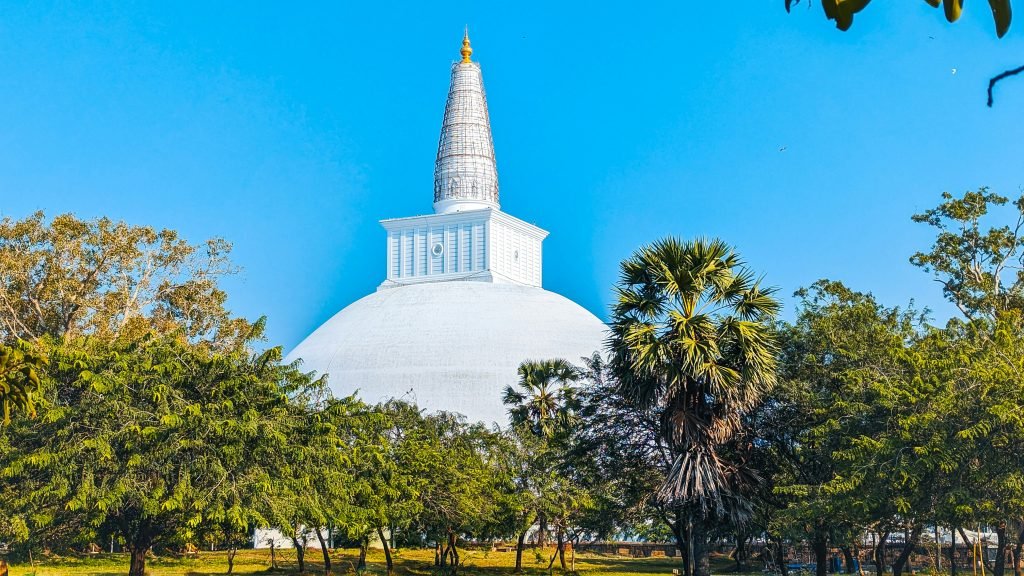
- Ruwanwelisaya. A huge, brilliant-white stupa with a gilded spire, and the image most people picture when they think of Anuradhapura.
- Jetavanaramaya and Abhayagiri. Two enormous brick stupas, now a deep red-brown, set among the ruins of the monasteries that once surrounded them. Both are covered by the main Anuradhapura ticket.
- Isurumuniya. A small rock temple known for its stone carvings, including the "Isurumuniya Lovers". It has its own small fee.
- Thuparamaya and the Samadhi Buddha. An early stupa ringed by slender stone pillars, and a much-loved seated Buddha statue in the woods nearby.
How to see it: the sites are spread over a wide area, so you'll want a tuk-tuk, a bicycle or your driver for the day. Start early, rest in the middle of the day, and finish at the stupas in the late afternoon, when the light is soft and the evening worship begins. Bring socks: you walk barefoot at the stupas, and the paving gets very hot by late morning.
Mihintale is about 12 km east of Anuradhapura. It's a hilltop temple complex reached by a long stone stairway, and it's where the monk Mahinda is said to have brought Buddhism to Sri Lanka in the 3rd century BC. It's worth adding if you're staying in Anuradhapura, ideally in the early morning.
Polonnaruwa: the medieval capital
After Anuradhapura fell in the late 10th century, the capital moved south-east to Polonnaruwa. Its golden age came under King Parakramabahu I in the 12th century, who built the vast Parakrama Samudra reservoir that still sits beside the town (UNESCO listing).
Polonnaruwa is the easiest of the ancient cities to enjoy. The ruins are close together, in good condition and set in shady parkland, and you can see the highlights in half a day.
What to see:
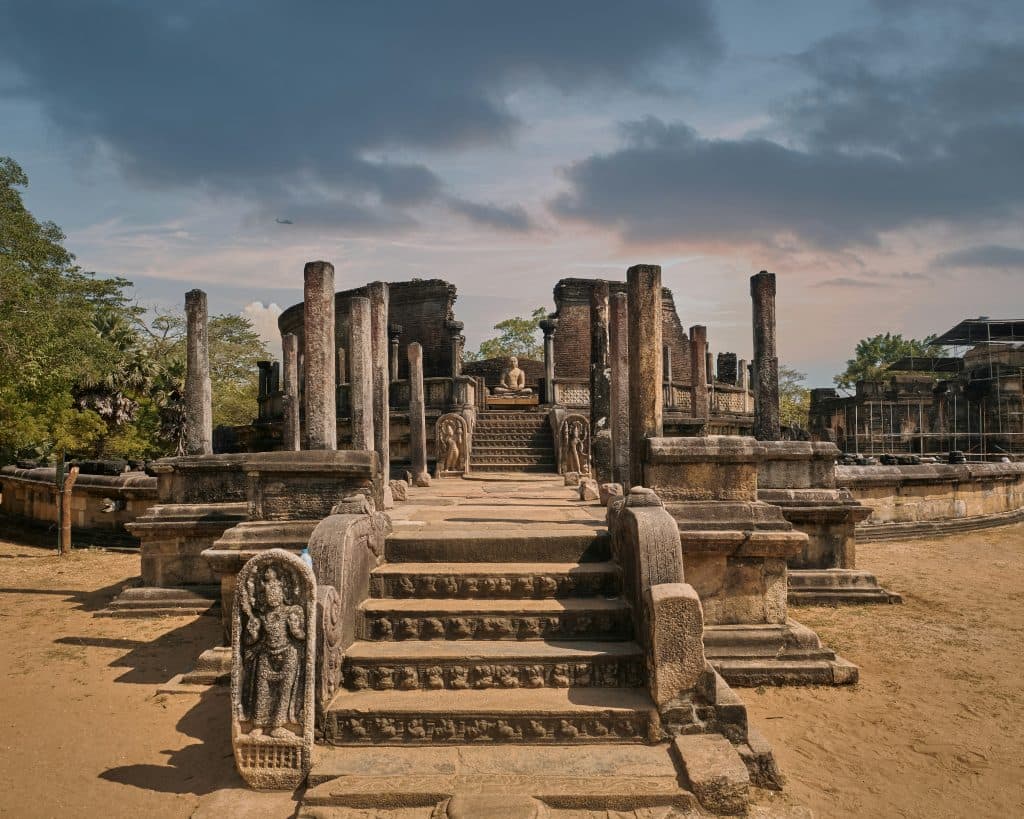
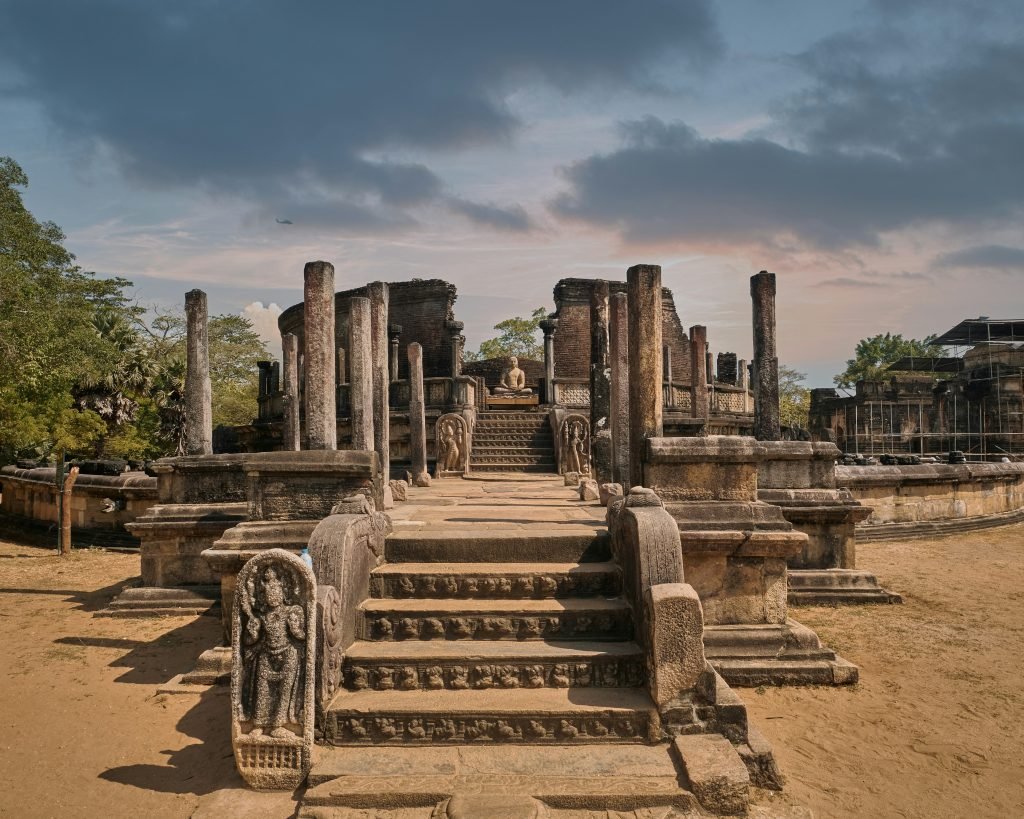
- The Quadrangle. A raised terrace packed with the city's finest buildings, including the Vatadage (a circular relic house with beautifully carved stairs and guardstones) and the Gal Pota, a giant stone "book" covered in inscriptions.
- The Royal Palace. Thick brick walls of what was once a multi-storey palace, plus the king's council chamber with its carved elephants and lions.
- Gal Vihara. Four large Buddha images carved into a single granite rock face, including a 14-metre reclining Buddha. For many people, this is the high point of the whole Cultural Triangle.
- Rankoth Vehera and Lankatilaka. A huge brick stupa and a tall, roofless image house with a headless standing Buddha inside.
How to see it: buy your ticket at the ticket office by the archaeological museum before you head into the site, and look round the museum first: it makes the ruins much easier to understand. The site runs north to south for a few kilometres, so a bicycle is the most popular way to get around. Guesthouses and shops near the entrance rent them out. A tuk-tuk or your driver works too.
Dambulla Cave Temple
The Dambulla cave temple (also called the Golden Temple or Rangiri Dambulla) is a group of five caves under a huge overhanging rock, about half an hour's drive from Sigiriya. The caves have been a place of worship for over 2,000 years. Inside, every surface is covered in painted murals, and there are more than 150 statues of the Buddha (UNESCO listing).
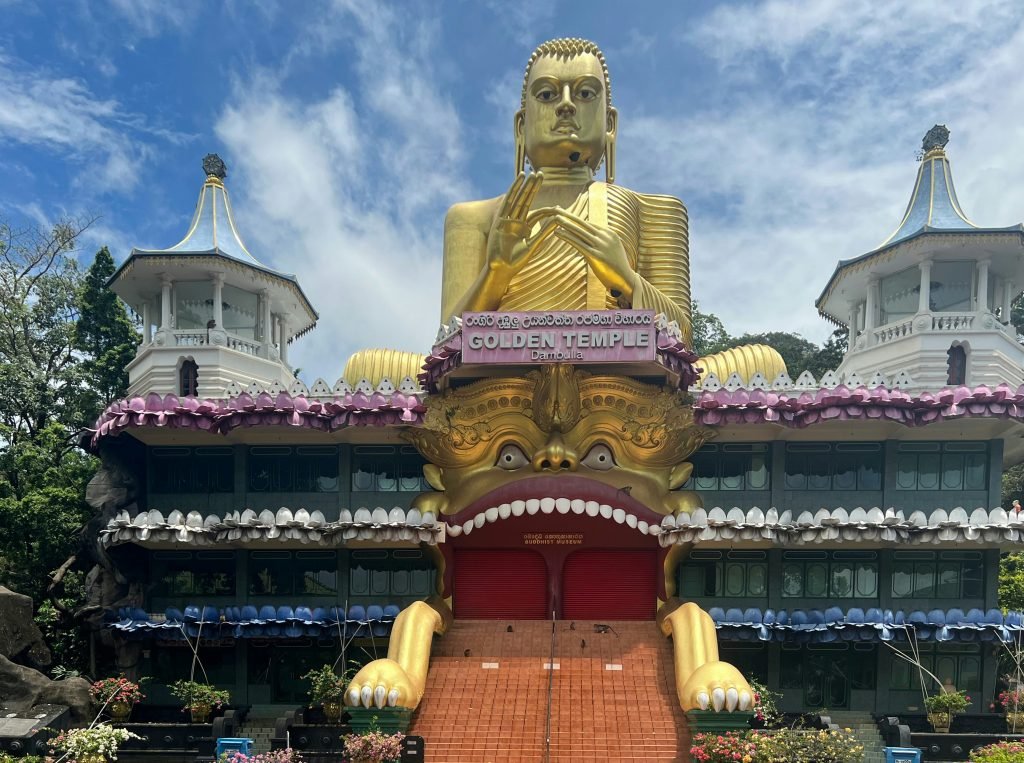
Visitors often get confused by the two parts of the site. At the bottom of the hill is the modern Golden Temple, with a giant gold Buddha on its roof and a museum. The ancient caves are at the top, up a stairway of a few hundred steps. The ticket is for the caves. Allow 1.5 to 2 hours in total.
Dress respectfully, with shoulders and knees covered, and leave your shoes at the shoe stand near the top. Keep a firm hold of snacks and bags on the stairs: the monkeys are bold.
Sigiriya and Pidurangala
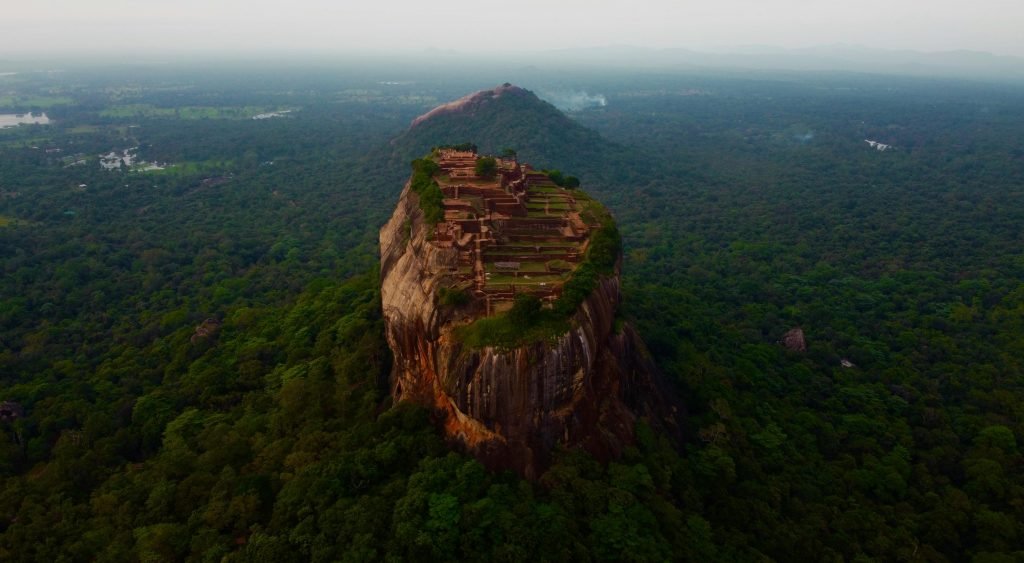
Sigiriya is the Cultural Triangle's most famous sight: a 5th-century palace built on the flat summit of a sheer rock, reached past frescoes and the giant Lion's Paws. Next door, Pidurangala Rock costs a fraction of the price and gives you the classic view of Sigiriya itself. Our Sigiriya guide covers the US$35 ticket, timing, the climb and how to choose between the two rocks.
How many days do you need?
- Two days: Sigiriya and Dambulla on day one, Polonnaruwa on day two. This is the classic short version and what most two-week itineraries include.
- Three days: add Pidurangala at sunrise, a jeep safari in Minneriya or Kaudulla National Park, or a slower day in Polonnaruwa by bike.
- Four to five days: add Anuradhapura and Mihintale with a night in Anuradhapura, and Ritigala on the way back.
Our 7-day Sri Lanka itinerary shows how the Cultural Triangle fits into a first trip.
Where to base yourself
- Sigiriya or Dambulla for most people. Both are central: Polonnaruwa, Dambulla and Sigiriya are all within roughly an hour or so by road of each other, and there's a wide range of guesthouses and hotels at every budget.
- Habarana, a crossroads town between Sigiriya and Polonnaruwa, is handy for safaris in Minneriya and Kaudulla.
- Anuradhapura itself if you want to see it properly. It's a long day trip from Sigiriya, and staying overnight lets you visit the stupas at the best times of day.
Getting there and getting around
There's no train to Sigiriya or Dambulla, so most visitors come by road. From Bandaranaike International Airport it's about four hours by car to Sigiriya; see our guide to getting from Colombo airport to Kandy, Ella, Galle and Sigiriya for every option.
With a driver. The easiest way to do the Cultural Triangle is with a car and driver, either for the whole trip or just for these few days. The sights are spread out, and a driver lets you start early and rest at midday. Read our guide to hiring a driver in Sri Lanka for daily rates.
By tuk-tuk and bus. Local buses link Dambulla with Sigiriya, Habarana, Polonnaruwa and Anuradhapura. They're cheap and frequent but slow and crowded. For day trips, many travellers hire a tuk-tuk for the day instead; agree the price first. Our tuk-tuk prices guide has current fares.
By train. Anuradhapura and Polonnaruwa are both on the railway, but services have been disrupted in 2026. The Maho to Anuradhapura section of the Northern line was closed for track upgrades from 19 January 2026, and News 1st reported on 3 November 2026 that Northern line services were suspended again after the Deduru Oya flooded. Trains on the Batticaloa line through Polonnaruwa resumed in January 2026. Check the current timetable with Sri Lanka Railways or at the station before you plan around a train.
Heading on to the hill country? After Cyclone Ditwah in November 2025, the hill country railway only runs between Nanu Oya, Ella and Badulla. Trains between Colombo, Kandy and Nanu Oya are suspended, so you'll need to drive from Kandy or Dambulla to Nanu Oya to ride the scenic stretch. Our Kandy to Ella train guide explains how.
Best time to visit
The Cultural Triangle is in Sri Lanka's dry zone. It gets most of its rain during the north-east monsoon, roughly from October to January, and is generally drier and sunnier from February to September. The middle of the day is very hot all year, so plan your ruins and climbs for early morning and late afternoon. Our month-by-month guide to the best time to visit Sri Lanka explains the monsoons in detail.
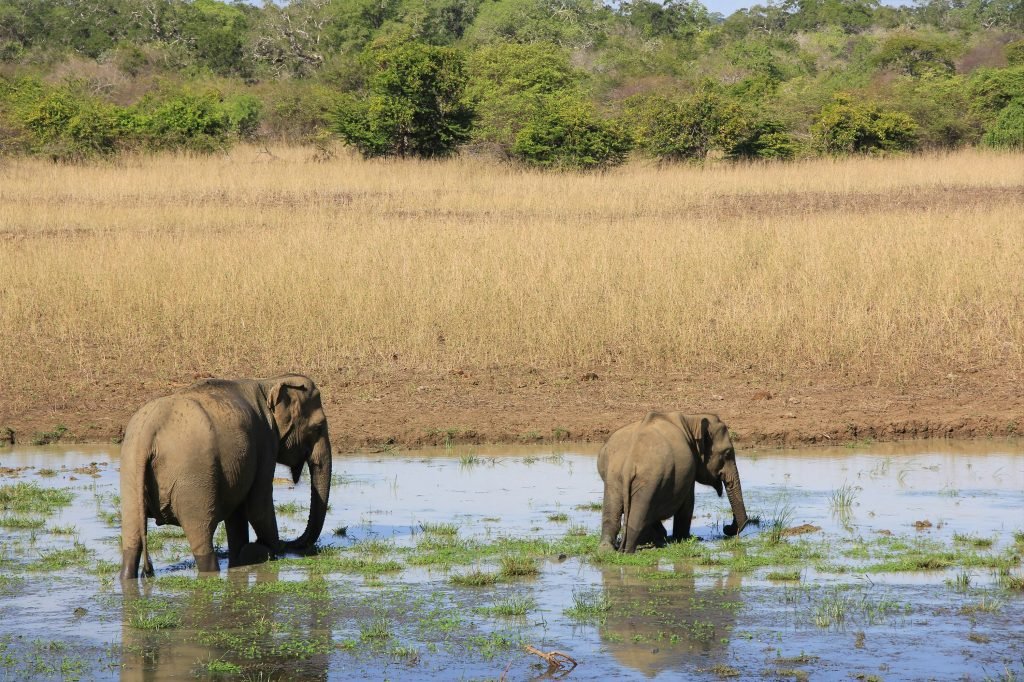
Wildlife fans should note the elephant "gathering", when large herds come to graze on the grass around the reservoirs in Minneriya and Kaudulla as the water drops. It's usually in the dry months of the second half of the year; ask your guesthouse or driver which park the herds are in when you visit. National park entry is US$25 per adult, plus the cost of the jeep.
Temple etiquette and practical tips
- Cover up. Wear clothes that cover your shoulders and knees at every temple and stupa, including the active shrines in Anuradhapura.
- Shoes and hats off. Remove both before entering temple grounds and stupa terraces. Socks help on hot stone.
- Respect Buddha images. Don't pose with your back to a Buddha statue, touch the statues or climb on ruins.
- Carry cash. Bring enough rupees for tickets, bicycles, tuk-tuks and drinks, as card payment isn't guaranteed at ticket counters. See our guide to money in Sri Lanka.
- Start early. Counters open at 7am. You'll get cooler temperatures, softer light and fewer tour groups.
- Bring water, a hat and sunscreen. There's little shade at some sites. Our Sri Lanka packing list covers the rest.
- Buy online if you like. The Central Cultural Fund sells tickets for Sigiriya, Anuradhapura, Polonnaruwa and Dambulla through its e-ticketing site; you then show your receipt at the counter. Its ticket page also mentions a Cultural Triangle round ticket for Sigiriya, Anuradhapura and Polonnaruwa, but doesn't publish the price, so ask at the counter whether it's on sale and whether it saves you money.
Frequently asked questions
Is Anuradhapura or Polonnaruwa better?
If you only have time for one, pick Polonnaruwa. It's closer to Sigiriya, more compact and easier to see in half a day. Anuradhapura is bigger, older and still an active pilgrimage city, and it's worth a dedicated day and night if you're interested in Buddhism or history.
How much does the Cultural Triangle cost in entrance fees?
For a foreign adult visiting Sigiriya, Dambulla, Polonnaruwa and Anuradhapura, the tickets add up to about US$95 plus Rs. 3,000 in 2026, before transport and guides. SAARC nationals pay half price at the main sites.
Can you visit Polonnaruwa as a day trip from Sigiriya?
Yes. It's one of the most popular day trips in the country. Leave early, see the ruins in the morning, and you can be back in time for an afternoon jeep safari or a rest by the pool.
Do I need a guide?
No, but a licensed guide makes the ruins far more interesting, especially in Anuradhapura, where the sites are spread out. Ask at the ticket office for an official guide rather than accepting offers from people at the gate.
Can I take the train to Anuradhapura?
Sometimes. The Northern line has had closures and suspensions during 2026, so check the current schedule before you count on it. Driving or taking the bus from Dambulla is the reliable option.